graph what you think happened to the elk population include levels prior to 1923

Wolf after re-introduction
The History of wolves in Yellowstone included extirpation, absence and reintroduction of the gray wolf (Canis lupus) to Yellowstone National Park. The reintroduction of wolves was controversial as information technology is with the worldwide reintroduction of wolves. When Yellowstone National Park was created in 1872, wolf populations were already in decline in Montana, Wyoming and Idaho.[ not verified in torso ] The creation of the national park did non provide protection for wolves or other predators, and government predator control programs in the first decades of the 1900s essentially helped eliminate the gray wolf from Yellowstone. The concluding wolves were killed in Yellowstone in 1926. After that, sporadic reports of wolves still occurred, but scientists confirmed that sustainable wolf populations had been extirpated and were absent from Yellowstone during the mid-1900s.[ non verified in torso ]
Starting in the 1940s, park managers, biologists, conservationists and environmentalists began, what would ultimately plough into, a campaign to reintroduce the gray wolf into Yellowstone National Park. When the Endangered Species Deed of 1973 was passed, the route to legal reintroduction was clear. In 1995, gray wolves were reintroduced into Yellowstone in the Lamar Valley.
Extirpation (1872–1926) [edit]

Soldiers displaying Wolf pelt at Soda Butte Creek patrol station, 1905
In 1872, when Yellowstone National Park was created, there was no legal protection for wildlife in the park still. In the early years of the park, administrators, hunters and tourists were essentially costless to impale any game or predator they came across. The gray wolf was especially vulnerable to this wanton killing because it was generally considered an undesirable predator and was being willingly extirpated throughout its N American range. In Jan 1883, the Secretarial assistant of the Interior issued regulations prohibiting hunting of about park animals, but the regulations did non apply to wolves, coyotes, bears, mountain lions and other minor predators.[1]
Presently subsequently the U.S. Regular army took over admin of the park on August 1, 1890, Captain Moose Harris, the first military machine superintendent, allowed public hunting of whatsoever wildlife and any predator control was to be left to the park's assistants.[two] Official records testify however, that the U.Southward. Army did not begin killing any wolves until 1914.[3]
In 1885, Congress created the Division of Economic Ornithology and Mammalogy with the express purpose of research for the protection of wildlife. The agency soon became the U.S. Biological Survey which was the precursor of the U.S. Fish and Wild animals Service. In 1907, under political pressure from the western cattle and livestock industries, this agency began a concerted program which eventually was called: Brute Damage Control. This predator control programme alone killed 1,800 wolves and 23,000 coyotes in 39 U.S. National Forests in 1907.[3] In 1916, when the National Park Service was created, its enabling legislation included words that authorized the Secretarial assistant of the Interior to "provide in his discretion for the devastation of such animals and of such plant life every bit may be detrimental to the utilise of said parks, monuments and reservations".[3]
It is mostly accepted that sustainable gray wolf packs had been extirpated from Yellowstone National Park by 1926,[1] although the National Park Service maintained its policies of predator control in the park until 1933.[3] However, a 1975–77 National Park Service sponsored study revealed that during the period 1927 to 1977, there were several hundred likely sightings of wolves in the park.[four] Between 1977 and the re-introduction in 1995, there were additional reliable sightings of wolves in the park, most believed to be singles or pairs transiting the region.[5]
Official records of wolves killed [edit]
Prior to the National Park Service assuming command of the park in 1916, the U.Due south. Army killed 14 wolves during their tenure (1886–1916),[iii] nigh in the years 1914–15.[i] In 1940, Adolph Murie, a noted wildlife biologist published his Fauna Series No. four— Creature of the National Parks of the United States-Ecology of the Coyote in the Yellowstone National Park. In this study, Murie tallied the number of wolves killed equally reported annually by park administrators between 1915 and 1935:[half dozen]
| From the Superintendent'due south Annual Report: | |
|---|---|
| Year | Number killed |
| 1915 | 7 |
| 1916 | xiv |
| 1917 | 4 |
| 1918 | 36 |
| 1919 | 6 |
| 1920 | 28 |
| 1921 | 12 |
| 1922 | 24 |
| 1923 | 8 |
| 1924–1935 | 0 |
Updated enquiry in the 1980s verified that the last official killing of wolves in the park took place in 1926 when 2 pups found about Soda Butte Creek were killed by park rangers.[7] The concluding reported wolf killed in the Greater Yellowstone Ecosystem (prior to today's legal hunting or control measures) occurred in May 1943 when Leo Cottenoir, a Native American sheepherder on the Wind River Reservation shot a wolf most the southern border of the park.[eight]
Absence (1926–1995) [edit]
Ecological impacts [edit]
Once the wolves were gone, elk populations began to rising. Over the next few years, conditions of Yellowstone National Park declined drastically. A team of scientists visiting Yellowstone in 1929 and 1933 reported, "The range was in deplorable conditions when we first saw it, and its deterioration has been progressing steadily since then." By this time many biologists were worried nearly eroding land and plants dying off. The elk were multiplying inside the park and deciduous, woody species such as aspen and cottonwood suffered from overgrazing. The park service started trapping and moving the elk and, when that was not effective, killing them. Elk population control methods continued for more than 30 years. Elk control prevented further deposition of the range, but didn't improve its overall condition. At times, people would mention bringing wolves dorsum to Yellowstone to help command the elk population. Yellowstone's managers were not eager to bring back wolves, peculiarly after and so successfully extirpating them from the park. Elk control continued into the 1960s. In the late 1960s, local hunters began to complain to their congressmen that at that place were too few elk, and the congressmen threatened to stop funding Yellowstone. Killing elk was given upwards every bit a command method which allowed elk populations to again rise. Equally elk populations rose, the quality of the range decreased affecting many other animals. Without wolves, coyote populations increased dramatically which adversely impacted the pronghorn antelope population.[9] However, information technology was the overly large elk populations that caused the most profound changes to the ecosystem of Yellowstone with the absenteeism of wolves.[10]
Reintroduction initiatives [edit]
The campaign to restore the grey wolf in Yellowstone had its roots in a number of seminal studies related to the predator-casualty ecology of the park. In 1940 Adolph Murie published Ecology of the Coyote in the Yellowstone National Park. That study and his 1940–41 piece of work The Wolves of Mount McKinley was instrumental in edifice a scientific foundation for wolf conservation.[11] In 1944, noted wildlife biologist Aldo Leopold, once an avid predator command advocate, made the following comments in his review of The Wolves of North America, Immature and Goldman, 1944:
There nevertheless remains, even in the U.s.a., some areas of considerable size in which we feel that both ruby and gray [wolves] may exist immune to proceed their existence with trivial molestation. ... Where are these areas? Probably every reasonable ecologist volition agree that some of them should lie in the larger national parks and wilderness areas: for case Yellowstone and its adjacent national forests. ... Why, in the necessary process of extirpating wolves from livestock ranges of Wyoming and Montana, were not some of the uninjured animals used to restock Yellowstone?
—Aldo Leopold, 1944[12]
Past the 1960s, cultural and scientific understanding of ecosystems was changing attitudes toward the wolf and other large predators. In part, this included the emergence of Robert Paine'southward concept of the keystone species. In the early on 1960s, Douglas Pimlott, a noted Canadian wildlife biologist was calling for the restorations of wolves in the northern rockies. In 1970 American wolf expert, David Mech published The Wolf: The Ecology and Behavior of an Endangered Species (1970, 1981), an enlightening study of the wolf and its bear on on its environment.[xiii] In 1978, when wild animals biologist John Weaver published his seminal study Wolves of Yellowstone, he ended the report with the following recommendation:
Therefore I recommend restoring this native predator by introducing wolves to Yellowstone
—John Weaver, National Park Service, 1978[4]
The gray wolf was one of the beginning species to be listed equally endangered (1967) under the Endangered Species Preservation Act of 1966.[14] Yet, until the passage of the Endangered Species Act of 1973, there was no legal basis or process for re-introducing the greyness wolf to Yellowstone National Park and the Greater Yellowstone Ecosystem.[13] The Endangered Species Act obligated the U.S. Fish and Wildlife Service to develop restoration plans for each species designated as Endangered. The kickoff recovery program was completed in 1980 simply gained little traction. In 1987, the U.S. Fish and Wildlife Service published a revised Northern Rocky Mountain Wolf Recovery Plan which led the way to wolf reintroduction. The plan was a cooperative attempt between the National Park Service, Fish and Wildlife Service, academia, country wild fauna agencies and environmental groups. Its Executive Summary contains the following:
The Northern Rocky Mountain Wolf Recovery Programme represents a "route map" to recovery 'of the greyness wolf in' the Rocky Mountains. The principal goal of the program is to remove the Northern Rocky Mount wolf from the endangered and threatened species listing past securing and maintaining a minimum of 10 convenance pairs of wolves in each of the three recovery areas for a minimum of three successive years.
—Northern Rocky Mount Wolf Recovery Programme, USFWS, August 1987[15]
In 1991 Congress directed the U.S. Fish and Wild animals Service to develop an Ecology Impact Statement (EIS) for the express purpose of reintroducing wolves into Yellowstone National Park and regions of Fundamental Idaho. The last statement was published on April 14, 1994, and seriously examined five potential alternatives for reestablishing wolves in Yellowstone and key Idaho.[16]
- Reintroduction of Experimental Populations (incorporating most of the land implemented nonessential reintroduction culling with parts of the 1987 Recovery Plan).
- Natural Recovery (with limited land-use restrictions in apprehension of some illegal killing of wolves).
- No wolf (equally proposed in alternative scoping).
- Wolf Management Commission (equally proposed by Congress).
- Reintroduction of Non-experimental Wolves (incorporating the accelerated wolf recovery alternative but with fewer land-utilize restrictions)
Culling ane was the recommended and ultimately adopted alternative:
Reintroduction of Experimental Populations Alternative – The purpose of this culling is to reach wolf recovery by reintroducing wolves designated as nonessential experimental populations to Yellowstone National Park and central Idaho and by implementing provisions within Department 10(j) of the ESA to behave special management to address local concerns. The states and tribes would be encouraged to implement the special rules for wolf management outside national parks and national wildlife refuges under cooperative agreement with the FWS.
—EIS-The Reintroduction of Wolves to Yellowstone National Park and Central Idaho, 1994[xvi] : 2.1–2.11
The last EIS opened the way for re-introduction, but not without opposition. The Sierra Club and National Audubon Order opposed the re-introduction plan on the grounds that Experimental populations were not protected enough in one case the wolves were outside the park. The Farm Bureau'south of Idaho, Wyoming and Montana opposed the programme on the footing that the incorrect subspecies of wolf—Canis lupus occidentalis (northwestern wolf (Canada)) instead of Canis lupus irremotus (Northern Rocky Mountains wolf) was selected for reintroduction. These objections were overcome and in January 1995, the process of physically reintroducing wolves into Yellowstone began.[17]
Reintroduction (1995–present) [edit]
Initial releases 1995–96 [edit]
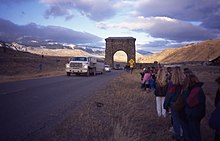
First wolves beingness transported into Yellowstone for release, January 1995
In Jan 1995, U.S. and Canadian wildlife officials captured xiv wolves from multiple packs east of Jasper National Park, most Hinton, Alberta, Canada. These wolves arrived in Yellowstone in ii shipments—Jan 12, 1995 (8 wolves) and January 20, 1995 (6 wolves). They were released into iii acclimation pens—Crystal Creek, Rose Creek and Soda Butte Creek in the Lamar Valley in Northeast Due east Yellowstone National Park. In March 1995, the pens were opened and between March 21 and March 31, 1995, all 14 wolves were loose in Yellowstone.[18]
Seventeen boosted wolves captured in Canada arrived in Yellowstone in January 1996 and were released into the park in April 1996 from the Chief Joseph, Lone Star, Druid Peak and Nez Perce pens. The reintroductions were planned on taking 3-v years simply these were the last wolves released into the park as officials believed that the natural reproduction and survival were sufficient.[eighteen] [19] [twenty]
Almanac wolf status since reintroduction [edit]

Yellowstone wolf pack territories in 2011
Wolf population declines, when they occur, result from "intraspecific strife," food stress, mange, canine distemper, legal hunting of wolves in areas outside the park (for sport or for livestock protection) and in one case in 2009, lethal removal past park officials of a human-habituated wolf.[21]
*1995-99 Information reflects condition of the wolf in the Greater Yellowstone Ecosystem. Since 2000 monitoring has focused on packs operating inside park boundaries. Wolves keep to spread to surrounding areas, and the last official report by the park for the Greater Yellowstone Area counted 272 wolves in 2002.
| Annual condition of Wolves in Yellowstone (equally of December)[22] | ||||
|---|---|---|---|---|
| Year | Total number of packs | Full number of wolves | Number of pups surviving | |
| 1995* | 3 | 21 | 9 | |
| 1996* | 9 | 51 | xiv | |
| 1997* | nine | 86 | 49 | |
| 1998* | xi | 112 | 36 | |
| 1999* | 11 | 118 | 38 | |
| 2000 | eight | 119 | 55-60 | |
| 2001 | ten | 132 | 43 | |
| 2002 | fourteen | 148 | 58 | |
| 2003 | xiii–14 | 174 | 59 | |
| 2004 | 16 | 171 | 59 | |
| 2005[23] | 13 | 118 | 22 | |
| 2006 | 13 | 136 | 60 | |
| 2007 | eleven | 171 | 64 | |
| 2008[24] | 12 | 124 | 22 | |
| 2009[21] | 14 | 96 | 23 | |
| 2010[25] | 11 | 97 | 38 | |
| 2011[26] | ten | 98 | 34 | |
| 2012[27] | 10 | 83 | 20 | |
| 2013[28] | ten | 95 | 41 | |
| 2014[29] | eleven | 104 | 40 | |
| 2015[xxx] | 10 | 98 | 35 | |
| 2016[31] | eleven | 108 | 36 | |
| 2017[32] | 11 | 97 | 21 | |
| 2018[33] | 9 | eighty | 24 | |
| 2019[34] | 8 | 94 | 42 | |
| 2020[35] | ix | 123 | 54 | |
Ecological impacts later on re-introduction [edit]
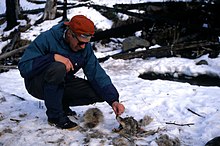
Rolf Peterson investigating the carcass of a coyote killed by a wolf in Yellowstone National Park, Jan 1996
Scientists accept been researching and studying the impacts on the Yellowstone ecosystem since re-introduction in 1995.
As the wolf population in the park has grown, the elk population, their favored casualty, has declined. Prior to reintroduction, the EIS predicted that wolves would kill an average 12 elk per wolf annually. This judge proved too depression equally wolves are now killing an average of 22 elk per wolf annually.[36] This decline in elk has resulted in changes in flora, near specifically willows, cottonwoods and aspens along the fringes of heavily timbered areas. Although wolf kills are direct attributable to declines in elk numbers, some research has shown that elk behavior has been significantly altered by wolf predation. The abiding presence of wolves take pushed elk into less favorable habitats, raised their stress level, lowered their nutrition and their overall birth rate.[37]
The wolves became significant predators of coyotes after their reintroduction. Since then, in 1995 and 1996, the local coyote population went through a dramatic restructuring. Until the wolves returned, Yellowstone National Park had i of the densest and nigh stable coyote populations in America due to a lack of human impacts. Two years afterward the wolf reintroductions, the pre-wolf population of coyotes had been reduced to fifty% through both competitive exclusion and intraguild predation. Coyote numbers were 39% lower in the areas of Yellowstone where wolves were reintroduced. In one study, about 16% of radio-collared coyotes were preyed upon by wolves. Yellowstone coyotes have had to shift their territories as a result, moving from open meadows to steep terrain. Carcasses in the open no longer attract coyotes; when a coyote is chased on flat terrain, it is often killed. They experience more secure on steep terrain where they volition often lead a pursuing wolf downhill. As the wolf comes afterwards it, the coyote will turn effectually and run uphill. Wolves, being heavier, cannot end and the coyote gains a large lead. Though concrete confrontations betwixt the two species are unremarkably dominated by the larger wolves, coyotes accept been known to assail wolves if they outnumber them. Both species will kill each other'south pups given the opportunity.[38] [39]
Coyotes, in their plough, naturally suppress foxes, so the macerated coyote population has led to a ascension in foxes, and "That in plough shifts the odds of survival for coyote prey such as hares and immature deer, too as for the small rodents and ground-nesting birds the foxes stalk. These changes affect how oftentimes certain roots, buds, seeds and insects get eaten, which alters the balance of local plant communities, and and so on downwardly the nutrient chain all the way to fungi and microbes."[xl]
The presence of wolves has also coincided with a dramatic ascension in the park's beaver population; where there was just 1 beaver colony in Yellowstone in 2001, at that place were nine beaver colonies in the park by 2011. The presence of wolves seems to have encouraged elk to browse more widely, diminishing their pressure on stands of willow, a plant that beavers need to survive the wintertime.[41] The renewed presence of beavers in the ecosystem has substantial furnishings on the local watershed because the being of beaver dams "even[s] out the seasonal pulses of runoff; store[s] water for recharging the water table; and provide[s] cold, shaded water for fish."[42] Beaver dams also counter erosion and create "new pond and marsh habitats for moose, otters, mink, wading birds, waterfowl, fish, amphibians and more."[40]
Similarly, afterwards the wolves' reintroduction, their increased predation of elk benefited Yellowstone's grizzly bear population, as it led to a significant increase in the growth of berries in the national park, an important food source for the grizzly bears.[43]
Wolf kills are scavenged by and thus feed a wide array of animals, including, simply not limited to, ravens, wolverines, baldheaded eagles, golden eagles, grizzly bears, black bears, jays, magpies, martens and coyotes.[40]
Meanwhile, wolf packs frequently merits kills made by cougars, which has driven that species back out of valley hunting grounds to their more than traditional mountainside territory.[40]
The superlative-down effect of the reintroduction of an apex predator like the wolf on other flora and fauna in an ecosystem is an example of a trophic cascade.
2009 removal from Endangered Species List [edit]
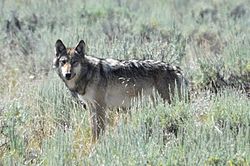
Because gray wolf populations in Montana, Wyoming and Idaho had recovered sufficiently to meet the goals of the Wolf Recovery Plan, on May 4, 2008, the U.S. Fish and Wild fauna Service changed the status of the gray wolf population known every bit the Northern Rocky Mountain Distinct Population Segment from Endangered to Experimental Population-Not Essential.[14]
The wolves in Yellowstone and the Greater Yellowstone Ecosystem fall inside this population. In response to the alter in status, country wild fauna authorities in Idaho and Montana enacted quota-based hunting seasons on wolves every bit part of their approved country Wolf Management Plans. Environmental groups objected to the delisting and the hunting seasons, simply despite legal attempts to terminate them (Defenders of Wildlife et al. 5 Ken Salazar et al.), the wolf hunts, which commenced in Montana in September 2009 were allowed to proceed.[ commendation needed ]
Although wolves within the park boundaries were all the same fully protected, wolves that ventured outside the boundaries of the park in Idaho or Montana could now exist legally hunted. During these hunts, Montana hunters legally killed a number of wolves in the Absaroka-Beartooth Wilderness known to frequent the northeast corner of the park.[44]
Reactions [edit]
Hunting opportunities [edit]

Yellowstone wolves chasing a bull elk
From 2000–2004, the Montana Fish, Wild animals and Parks reduced antlerless permits by 51% from two,882 to ane,400. They proposed just 100 permits for 2006 which was a 96% decrease from the 2,660 permits issued in 1995. Initially, the effects of wolf predation on elk during the first five years of the recovery were not detected, as elk numbers were identical to those of 1980–1994. From the winter of 1995 to the wintertime of 2004 however, the elk greatly decreased in number, dropping from 16,791 to viii,335 as the number of wolves on the northern range increased from 21 to 106, though predation from bears, increased human harvests, more severe winter and droughts were likewise factors. Since 2000, 45% of known deaths and 75% of predation-caused deaths of radio collared moo-cow-elk have been confirmed to exist attributable to wolves. Human being caused deaths in the same period accounted for viii–30% of known deaths. Yellowstone elk incorporate up to 92% of the winter diet of wolves, the overall kill rates of Yellowstone wolves on elk in winter being estimated at 22 ungulates per wolf annually. This is higher than the 12 ungulates per wolf rate predicted in the ESA.[45]
Subspecies [edit]
Historically, the wolf populations originally native to Yellowstone were classed under the subspecies C. l. irremotus. When the issue of what subspecies to use for the introduction was raised, U.Southward. Fish and Wild fauna Service representatives stated that the taxonomy of gray wolves had been revised numerous times, and that C. 50. irremotus was not a singled-out subspecies, only a geographical variant. Three publications were made on the appropriateness of using a founding population of Canadian wolves: Brewster and Fritz supported the motion, while Nowak determined that the original Yellowstone wolves were more similar to C. l. nubilus, a subspecies already nowadays in Minnesota, and that the Canadian animals proposed by Brewster and Fritz were of the subspecies C. fifty. occidentalis, a significantly larger animal. The rationale behind Brewster and Fritz'southward favor was that wolves prove little genetic diversity, and that the original population was extinct anyhow. This was contradicted by Nowak, who contested that Minnesotan wolves were much more similar in size and shape to the original population than the proposed Canadian wolves, though he conceded that C. l. occidentalis was probably already migrating southward even before human intervention. Doug Smith states that the size difference between the introduced wolves and the original wolves was really only a 6-vii percentage difference and Minnesotan wolves had no experience with elk and bison and were non adapted to mountainous terrain.[46] Smith and Yellowstone National Park deny the merits that the "wrong wolf" was introduced.[47]
In popular culture [edit]
- The podcast Criminal covered the killing of Wolf x (a male) in their episode, "Wolf 10."[48] Their sister podcast, This is Love, produced an episode about the reintroduction of wolves to Yellowstone, and focused on the stories of Wolves viii (male), 21 (male), and 42 (female person).[49]
Run across likewise [edit]
- O-Half-dozen, dominant convenance female ("blastoff female") of the Lamar Coulee pack, whose death past hunting merely outside Yellowstone received extensive media coverage and was the subject of a bestselling book by Nate Blakelee.
- OR-7, starting time confirmed wild wolf in western Oregon since 1947 and the first in California since 1924
- Repopulation of wolves in California began in 2011
- Repopulation of wolves in Colorado includes the natural expansion and proposed reintroduction
- Repopulation of wolves in the Midwestern states of Michigan, Minnesota, and Wisconsin occurred naturally
- List of grey wolf populations by country
- Wolf distribution (species distribution)
- Yellowstone (British TV serial)
References [edit]
- ^ a b c Haines, Aubrey L. (1996). The Yellowstone Story—A History of Our First National Park. Vol. 2. Niwot, CO: University Press of Colorado. pp. eighty–82. ISBN0-87081-391-nine.
- ^ Schullery, Paul (1997). Searching for Yellowstone: Ecology and Wonder in the Final Wilderness . Boston: Houghton Mifflin Co. p. 125. ISBN0-395-84174-7.
- ^ a b c d east Chase, Alston (1986). "The Wolf Mystery". Playing God in Yellowstone—The Destruction of America'south Beginning National Park. Boston, MA: The Atlantic Monthly Press. pp. 120–125. ISBN0-87113-025-4.
- ^ a b Weaver, John (1996). "The Wolves of Yellowstone". In Schullery, Paul (ed.). The Yellowstone Wolf—A Guide and Sourcebook. Worland, WY: Loftier Plains Publishing. pp. 3–33. ISBN1-881019-thirteen-6.
- ^ Schullery, Paul, ed. (1996). "Chapter 12—Greyness Wolf Monitoring in Yellowstone National Park". The Yellowstone Wolf—A Guide and Sourcebook. Worland, WY: Loftier Plains Publishing. pp. 112–117. ISBNane-881019-13-6.
- ^ Murie, Adolph (1940). Brute of the National Parks of the United states-Ecology of the Coyote in the Yellowstone National Park (Report). U.S. Section of the Interior.
- ^ Fischer, Hank (1995). "How The West was Lost". Wolf Wars— The Remarkable Inside Story of the Restoration of Wolves to Yellowstone. Helena, MT: Falcon Press Publishing Co. Inc. pp. x–23. ISBNi-56044-352-9.
- ^ Schullery, Paul, ed. (1996). "Chapter seven The Last Wolf 1943 An Interview with Leo Cottenoir 1992". The Yellowstone Wolf—A Guide and Sourcebook. Worland, WY: High Plains Publishing. pp. 92–96. ISBN1-881019-13-vi.
- ^ Kim Murray Berger, Eric Chiliad. Gese, and Joel Berger (2008). "Indirect Furnishings and Traditional Trophic Cascades: A Test Involving Wolves, Coyotes, And Pronghorn". Ecology. 89 (3): 818–828. doi:10.1890/07-0193.1. PMID 18459344.
{{cite journal}}: CS1 maint: uses authors parameter (link) - ^ Stolzenburg, William (2008). Where the Wild Things Were. Jeffers Literary Press.
- ^ Fischer, Hank (1995). "Carriers of the Torch". Wolf Wars—The Remarkable Within Story of the Restoration of Wolves to Yellowstone. Helena, MT: Falcon Printing Publishing Co. Inc. pp. 24–34. ISBNi-56044-352-9.
- ^ Schullery, Paul, ed. (1996). "Chapter 8—Review of the Wolves of Northward America, Aldo Leopold". The Yellowstone Wolf—A Guide and Sourcebook. Worland, WY: Loftier Plains Publishing. pp. 97–98. ISBN1-881019-thirteen-half-dozen.
- ^ a b Fischer, Hank (1995). "From Varmints to Rock Stars". Wolf Wars—The Remarkable Inside Story of the Restoration of Wolves to Yellowstone. Helena, MT: Falcon Press Publishing Co. Inc. pp. 35–43. ISBN1-56044-352-ix.
- ^ a b "Species Profile-Gray Wolf". U.S. Fish and Wildlife Service. Retrieved 2009-12-05 .
- ^ Northern Rocky Mountain Wolf Recovery Plan (PDF) (Report). Denver, CO: U.S. Fish and Wild fauna Service. 1987.
- ^ a b The Reintroduction of Grey Wolves to Yellowstone National Park and Central Idaho-Final Environmental Impact Statement (PDF) (Report). Denver, CO: U.S. Fish and Wildlife Service. 1994. Archived from the original (PDF) on 2012-05-01. Retrieved 2009-12-05 .
- ^ Fischer, Hank (1995). "Wolf Wars". Wolf Wars—The Remarkable Inside Story of the Restoration of Wolves to Yellowstone. Helena, MT: Falcon Press Publishing Co. Inc. pp. 143–157. ISBNane-56044-352-nine.
- ^ a b Phillips, Michael K; Smith Douglas W. (1997). Yellowstone Wolf Project-Biennial Written report 1995–96 (PDF) (Report). National Park Service.
- ^ Smith, Douglas Westward. (1998). Yellowstone Wolf Project—Annual Study 1997 (PDF) (Report). National Park Service.
- ^ Hayward, Matt W.; Somers, Michael (2009-05-06). Reintroduction of Height-Order Predators. John Wiley & Sons. ISBN978-1-4443-1202-7.
- ^ a b "Yellowstone Wolf Project, Annual Report 2009" (PDF) . Retrieved 2018-02-05 .
- ^ Annual Wolf Project Reports, Yellowstone National Park, 1995–2008
- ^ "wolf2005.indd" (PDF) . Retrieved 2018-02-05 .
- ^ Smith, D.W., D.R. Stahler, E. Albers, M. Metz, L. Williamson, N. Ehlers, One thousand. Cassidy, J. Irving, R. Raymond, East. Almberg, and R. McIntyre (2009). Yellowstone Wolf Project—2008 Almanac Report (PDF) (Report). Yellowstone Center for Resources, Yellowstone National Park, National Park Service. pp. six.
{{cite report}}: CS1 maint: multiple names: authors list (link) - ^ [NPS.gov: Wolves of Yellowstone, http://world wide web.nps.gov/yell/naturescience/wolves.htm, visited 10/28/2011]
- ^ http://www.nps.gov/yell/naturescience/upload/Wolf_AR_2011.pdf[ bare URL PDF ]
- ^ "Yellowstone Wolf Projection, Annual Written report 2012" (PDF) . Retrieved 2018-02-05 .
- ^ "Yellowstone Wolf Projection, Annual Report 2013" (PDF) . Retrieved 2018-02-05 .
- ^ "Yellowstone Wolf Project, Almanac Report 2014" (PDF) . Retrieved 2019-02-07 .
- ^ "Yellowstone Wolf Project, Annual Study 2015" (PDF) . Retrieved 2019-02-07 .
- ^ "Wolves in Yellowstone National Park". National Park Service . Retrieved thirteen Dec 2017.
- ^ "Yellowstone Wolf Project, Almanac Written report 2017" (PDF) . Retrieved 2019-02-07 .
- ^ "Yellowstone Wolf Project, Annual Report 2018" (PDF) . Retrieved 2021-05-01 .
- ^ "Yellowstone Wolf Project, Annual Study 2019" (PDF) . Retrieved 2021-05-01 .
- ^ "Yellowstone Wolf Project, Annual Report 2020" (PDF) . Retrieved 2022-03-29 .
- ^ White, P.J.; Smith, Douglas Due west. (Wintertime 2005). "Wolf EIS Predictions and Ten-Year Appraisals" (PDF). Yellowstone Scientific discipline. 13 (i): 34–41.
- ^ Ellig, Tracy (July xv, 2009). "Greater Yellowstone elk suffer worse nutrition and lower birth rates due to wolves". Montana State University News Service. Archived from the original on September 23, 2009. Retrieved Dec 8, 2009.
- ^ "Weaving A New Web: Wolves Alter An Ecosystem" Archived 2009-01-24 at the Wayback Machine, Zoogoer magazine, May/June 1998, Smithsonian National Zoo
- ^ "Coyotes Cower in Wolf Territory". Livescience. 11 September 2007. Retrieved 2008-03-xx .
- ^ a b c d Douglas H. Chadwick (June–July 2011). "Keystone Species: How Predators Create Abundance and Stability". Mother Earth News.
- ^ "Beyond the Headlines". Living on Globe. March xx, 2015. Retrieved March 22, 2015.
- ^ YELLOWSTONE NATIONAL PARK WOLF REINTRODUCTION IS CHANGING THE FACE OF THE GREATER YELLOWSTONE ECOSYSTEM, YellowstonePark.com, Past STAFF, JUNE 21, 2011, visited x/28/2011 Archived October 21, 2011, at the Wayback Machine
- ^ Barber, Elizabeth (29 July 2013). "Why the return of the wolf is skillful news for the acquit". Christian Scientific discipline Monitor. Retrieved 30 July 2017.
- ^ "Three Yellowstone Wolves Killed During Montana's Hunting Season". National Parks Traveler. Retrieved December 31, 2021.
- ^ Yellowstone National Park'due south gray wolves touch elk Archived 2009-08-ten at the Wayback Auto
- ^ "Archived re-create". Archived from the original on 2015-08-12. Retrieved 2015-07-xx .
{{cite web}}: CS1 maint: archived copy as championship (link) - ^ "Wolf -Bison Interactions in Yellowstone National Park". Academy of Nebraska.
- ^ "Wolf 10". Criminal. April 3, 2020.
- ^ "The Wolves". This is Love. April 1, 2020.
Further reading [edit]
- Urbigkit, Cat (2008). Yellowstone Wolves: A Chronicle of the Animal, the People, and the Politics. Blacksburg, VI: McDonald & Woodward Publishing. ISBN978-0-939923-lxx-0.
- Bartlett, Richard A. (1974). Nature'due south Yellowstone . Albuquerque, NM: Academy of New Mexico Press. ISBN9780826302571.
- Haines, Aubrey L. (1977). The Yellowstone Story—A History of Our First National Park. Yellowstone National Park, WY: Yellowstone Library and Museum Association.
- Chase, Alston (1986). Playing God in Yellowstone—The Devastation of America's First National Park. Boston, MA: The Atlantic Monthly Press. ISBN0-87113-025-four.
- Bartlett, Richard (1985). Yellowstone: A Wilderness Besieged . Tucson, AZ: University of Arizona Press. ISBN0-8165-1098-9.
- Northern Rocky Mount Wolf Recovery Plan (PDF) (Report). Denver, CO: U.S. Fish and Wildlife Service. 1987.
- The Reintroduction of Grey Wolves to Yellowstone National Park and Central Idaho-Final Environmental Bear on Statement (PDF) (Report). Denver, CO: U.S. Fish and Wildlife Service. 1994. Archived from the original (PDF) on 2012-05-01. Retrieved 2009-12-05 .
- Fischer, Hank (1995). Wolf Wars—The Remarkable Inside Story of the Restoration of Wolves to Yellowstone. Helena, MT: Falcon Press Publishing Co. Inc. ISBN1-56044-352-9.
- Schullery, Paul, ed. (1996). The Yellowstone Wolf—A Guide and Sourcebook. Worland, WY: High Plains Publishing. ISBN1-881019-thirteen-half dozen.
- Kay, Charles E. (January 1996). Wolf Recovery, Political Ecology and Endangered Species (Report). The Independent Institute.
- Schullery, Paul (1997). Searching for Yellowstone: Environmental and Wonder in the Final Wilderness. Boston: Houghton Mifflin Co. ISBN0-395-84174-vii.
- McNamee, Thomas (1997). The Return of the Wolf to Yellowstone. New York: Henry Holt and Company, Inc. ISBN0-8050-3101-iv.
- Jones, Karen R. (2002). Wolf Mountains-A History of Wolves along the Great Divide. Calgary, Ontario: University of Calgary Press. ISBNane-55238-072-6.
- Smith, Douglas O. (September 2003). Management of Habituated Wolves in Yellowstone National Park (PDF) (Report). National Park Service.
- Rydell, Kiki Leigh; Culpin, Mary Shivers (2006). Managing the "Matchless Wonders—A History of Authoritative Evolution in Yellowstone National Park 1872–1965 (Report). Yellowstone Center for Resource.
- Bangs, Ed; Barbee, Bob; Petersen, Rolf O. (Winter 2005). "Perspectives on Wolf Restoration" (PDF). Yellowstone Science. xiii (1): 4–half-dozen.
- Smith, Douglas W. (Wintertime 2005). "10 Years of Yellowstone Wolves, 1995–2005" (PDF). Yellowstone Science. xiii (1): 7–32.
- White, P.J.; Smith, Douglas Westward. (Winter 2005). "Wolf EIS Predictions and X-Twelvemonth Appraisals" (PDF). Yellowstone Science. 13 (1): 34–41.
- "Technical Publications on Wolves, 1995–2004" (PDF). Yellowstone Scientific discipline. xiii (1): 42–43. Winter 2005.
- Duffield, John, Chris Neher, and David Patterson (September 2006). Wolves and People in Yellowstone: Impacts on the Regional Economic system (PDF) (Report). Yellowstone Park Foundation.
{{cite report}}: CS1 maint: multiple names: authors list (link) - Smith, D.W., D.R. Stahler, Eastward. Albers, M. Metz, 50. Williamson, Due north. Ehlers, K. Cassidy, J. Irving, R. Raymond, E. Almberg, and R. McIntyre (2009). Yellowstone Wolf Project - 2008 Annual Study (PDF) (Written report). Yellowstone Middle for Resources, Yellowstone National Park, National Park Service.
{{cite written report}}: CS1 maint: multiple names: authors list (link)
Source: https://en.wikipedia.org/wiki/History_of_wolves_in_Yellowstone
0 Response to "graph what you think happened to the elk population include levels prior to 1923"
ارسال یک نظر