What Broad Distinction Can Be Made Between Most Animal Behavior and Most Human Behavior?
Studying Sociology
Sociological studies range from the analysis of conversations and behaviors to the development of theories in club to understand how the globe works.
Learning Objectives
Identify means in which folklore is applied in the existent earth
Key Takeaways
Key Points
- Sociology uses both quantitative and qualitative methods to report both contiguous human social interactions and big scale social trends.
- Sociology uses empirical and critical assay methods to study human social interaction.
- Folklore includes both macrosociology and microsociology; microsociology examines the study of people in face-to-face interactions, and macrosociology involves the written report of widespread social processes.
- Sociology is a co-operative of the social sciences that uses systematic methods of empirical investigation and critical assay to develop and refine a body of knowledge well-nigh human social structure and activity.
Fundamental Terms
- sociology: The study of society, human social interaction, and the rules and processes that bind and dissever people, not only as individuals, only as members of associations, groups, and institutions
- quantitative: Of a measurement based on some quantity or number rather than on some quality.
- qualitative: Of descriptions or distinctions based on some quality rather than on some quantity.
Sociology is the report of human social life. Sociology has many sub-sections of study, ranging from the analysis of conversations to the development of theories to try to understand how the entire globe works. This chapter will introduce you to folklore and explain why information technology is important and how it can alter your perspective of the world around you, and give a brief history of the discipline.
Sociology is a branch of the social sciences that uses systematic methods of empirical investigation and critical analysis to develop and refine a body of knowledge nigh human social structure and activity. Sometimes the goal of sociology is to use such knowledge to the pursuit of authorities policies designed to do good the general social welfare. Its subject matter ranges from the micro level to the macro level. Microsociology involves the study of people in face-to-face interactions. Macrosociology involves the study of widespread social processes. Sociology is a broad discipline in terms of both methodology and subject matter. The traditional focuses of sociology have included social relations, social stratification, social interaction, culture, and deviance, and the approaches of sociology have included both qualitative and quantitative research techniques.
Much of what homo action falls nether the category of social structure or social activity; because of this, folklore has gradually expanded its focus to such far-flung subjects as the study of economic activity, wellness disparities, and even the function of social activeness in the cosmos of scientific knowledge. The range of social scientific methods has also been broadly expanded. For case, the "cultural turn" of the 1970s and 1980s brought more than humanistic interpretive approaches to the study of civilisation in sociology. Conversely, the same decades saw the rise of new mathematically rigorous approaches, such as social network analysis.
The Sociological Imagination
The sociological imagination is the ability to situate personal troubles within an informed framework of larger social processes.
Learning Objectives
Discuss C. Wright Mills' merits concerning the importance of the "sociological imagination" for individuals
Cardinal Takeaways
Central Points
- Because they tried to understand the larger processes that were affecting their own personal experience of the globe, it might exist said that the founders of sociology, like Marx, Weber, and Durkheim, exercised what C. Wright Mills later called the sociological imagination.
- C. Wright Mills, a prominent mid-20th century American sociologist, described the sociological imagination equally the ability to situate personal troubles and life trajectories inside an informed framework of larger social processes.
- Other scholars afterward Mills have employed the phrase more generally, as the type of insight offered by sociology and its relevance in daily life. Some other way of describing sociological imagination is the agreement that social outcomes are shaped past social context, actors, and social actions.
Central Terms
- the sociological imagination: Coined by C. Wright Mills, the sociological imagination is the power to situate personal troubles and life trajectories within an informed framework of larger social processes.
The Sociological Imagination
Early sociological theorists, like Marx, Weber, and Durkheim, were concerned with the phenomena they believed to be driving social modify in their time. Naturally, in pursuing answers to these large questions, they received intellectual stimulation. These founders of sociology were some of the earliest individuals to apply what C. Wright Mills (a prominent mid-20th century American sociologist) would later call the sociological imagination: the ability to situate personal troubles and life trajectories within an informed framework of larger social processes. The term sociological imagination describes the type of insight offered by the discipline of sociology. While scholars have quarreled over interpretations of the phrase, information technology is also sometimes used to emphasize sociology'southward relevance in daily life.

Émile Durkheim: Durkheim formally established the academic discipline and, with Karl Marx and Max Weber, is unremarkably cited equally the principal builder of modern social science and father of sociology.

Karl Marx: Karl Marx, some other ane of the founders of sociology, used his sociological imagination to understand and critique industrial guild.
C. Wright Mills
In describing the sociological imagination, Mills asserted the following. "What people need… is a quality of heed that will assistance them to use data and to develop reason in gild to achieve lucid summations of what is going on in the world and of what may be happening within themselves. The sociological imagination enables its possessor to understand the larger historical scene in terms of its meaning for the inner life and the external career of a variety of individuals. " Mills believed in the ability of the sociological imagination to connect "personal troubles to public issues. "
Equally Mills saw it, the sociological imagination helped individuals cope with the social world by enabling them to pace exterior their own, personal, self-centered view of the globe. By employing the sociological imagination, private people are forced to perceive, from an objective position, events and social structures that influence behavior, attitudes, and culture.
In the decades later on Mills, other scholars accept employed the term to depict the sociological approach in a more full general fashion. Some other style of defining the sociological imagination is the understanding that social outcomes are shaped past social context, actors, and actions.
Folklore and Science
Early sociological studies were thought to be like to the natural sciences due to their use of empiricism and the scientific method.
Learning Objectives
Contrast positivist sociology with "verstehen"-oriented sociological approaches
Key Takeaways
Key Points
- Early sociological approaches were primarily positivist—they treated sensory data every bit the sole source of authentic noesis, and they tried to predict human being beliefs.
- Max Weber and Wilhelm Dilthey introduced the idea of verstehen, which is an endeavour to understand and interpret meanings behind social behavior.
- The departure betwixt positivism and verstehen has frequently been understood as the deviation betwixt quantitative and qualitative sociology.
- Quantitative sociology seeks to respond a question using numerical analysis of patterns, while qualitative sociology seeks to make it at deeper a understanding based on how people talk about and interpret their actions.
Key Terms
- positivism: A doctrine that states that the simply authentic knowledge is scientific knowledge, and that such knowledge tin can only come from positive affirmation of theories through strict scientific method, refusing every form of metaphysics.
- Verstehen: A systematic interpretive procedure of understanding the pregnant of activity from the role player'due south bespeak of view; in the context of High german philosophy and social sciences in general, the special sense of "interpretive or participatory examination" of social phenomena.
- empirical: Pertaining to, derived from, or testable past observations made using the physical senses or using instruments which extend the senses.
Early on sociological studies considered the field of sociology to be similar to the natural sciences, similar physics or biology. Equally a issue, many researchers argued that the methodology used in the natural sciences was perfectly suited for use in the social sciences. The upshot of employing the scientific method and stressing empiricism was the distinction of sociology from theology, philosophy, and metaphysics. This also resulted in sociology being recognized as an empirical science.
Positivism and Verstehen
This early sociological approach, supported by August Comte, led to positivism, an thought that data derived from sensory feel and that logical and mathematical treatments of such data are together the exclusive source of all accurate knowledge. The goal of positivism, like the natural sciences, is prediction. But in the case of sociology, positivism's goal is prediction of human being behavior, which is a complicated proposition.
The goal of predicting human behavior was quickly realized to exist a bit lofty. Scientists like Wilhelm Dilthey and Heinrich Rickert argued that the natural world differs from the social world; human society has civilisation, unlike the societies of nearly other animals. The behavior of ants and wolves, for example, is primarily based on genetic instructions and is not passed from generation to generation through socialization. Every bit a issue, an boosted goal was proposed for folklore. Max Weber and Wilhelm Dilthey introduced the concept of verstehen. The goal of verstehen is less to predict beliefs than it is to empathise behavior. Weber said that he was after meaningful social action, not merely statistical or mathematical knowledge about social club. Arriving at a verstehen-like understanding of club thus involves non only quantitative approaches, just more interpretive, qualitative approaches.
The disability of sociology and other social sciences to perfectly predict the beliefs of humans or to fully comprehend a dissimilar culture has led to the social sciences existence labeled "soft sciences. " While some might consider this label derogatory, in a sense it tin can exist seen as an admission of the remarkable complexity of humans as social animals. Any animal every bit complex as humans is bound to be hard to fully comprehend. Humans, human club, and human civilization are all constantly irresolute, which means the social sciences will constantly be works in progress.
Quantitative and Qualitative Sociology
The contrast between positivist sociology and the verstehen approach has been reformulated in mod folklore as a stardom betwixt quantitative and qualitative methodological approaches, respectively. Quantitative sociology is generally a numerical approach to understanding human beliefs. Surveys with large numbers of participants are aggregated into information sets and analyzed using statistics, assuasive researchers to discern patterns in human behavior. Qualitative folklore by and large opts for depth over latitude. The qualitative approach uses in-depth interviews, focus groups, or the analysis of content sources (books, magazines, journals, Television receiver shows, etc.) as information sources. These sources are then analyzed systematically to discern patterns and to arrive at a better agreement of human behavior.
Drawing a hard and fast distinction between quantitative and qualitative sociology is a bit misleading, nonetheless. Both share a like arroyo in that the first pace in all sciences is the development of a theory and the generation of testable hypotheses. While there are some individuals who begin analyzing data without a theoretical orientation to guide their assay, almost brainstorm with a theoretical idea or question and gather data to test that theory. The second step is the collection of data, and this is really where the ii approaches differ. Quantitative folklore focuses on numerical representations of the enquiry subjects, while qualitative sociology focuses on the ideas found within the discourse and rhetoric of the research subjects.
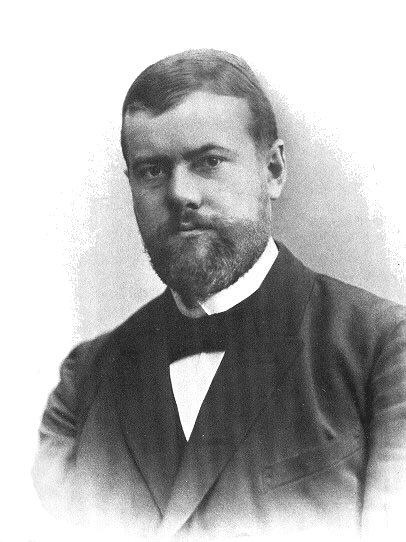
Max Weber: Max Weber and Wilhelm Dilthey introduced verstehen—agreement behaviors—as goal of folklore.
Sociology and the Social Sciences
As a social science, sociology explores the application of scientific methods to the study of the human aspects of the world.
Learning Objectives
Clarify the similarities and differences betwixt the social sciences
Key Takeaways
Key Points
- In the 17th century, scholars began to ascertain the natural earth every bit a reality separate from human or spiritual reality. As such, they thought the natural world should be studied using scientific and empirical methods.
- The pressure to discover mathematical relationships between objects of study carried into the study of human beliefs, thus distinguishing social sciences from the humanities.
- By the 19th century, scholars began studying human behavior from a scientific perspective in an endeavour to detect law-like properties of man interaction.
- In the attempt to report man behavior using scientific and empirical principles, sociologists always come across dilemmas, as humans do not always operate predictably according to natural laws.
- Even as Durkheim and Marx formulated law-like models of the transition from pre-industrial to industrial societies, Weber was interested in the seemingly "irrational" ideas and values, which, in his view, also contributed to the transition.
Key Terms
- humanities: The humanities are bookish disciplines that report the human condition, using methods that are primarily belittling, critical, or speculative, as distinguished from the mainly empirical approaches of the natural sciences.
- science: A particular discipline or branch of learning, especially i dealing with measurable or systematic principles rather than intuition or natural ability.
- social science: A branch of scientific discipline that studies order and the human behavior in information technology, including anthropology, communication studies, criminology, economics, geography, history, political scientific discipline, psychology, social studies, and sociology.
As a social science, sociology involves the application of scientific methods to the written report of the human being aspects of the world. The social science disciplines also include psychology, political science, and economics, among other fields. As a generalization, psychology is the study of the human mind and micro-level (or individual) behavior; folklore examines human being lodge; psychology focuses on mental and idea processes (internal), whereas sociology focuses on human behavior (external). Political science studies the governing of groups and countries; and economic science concerns itself with the product and allocation of wealth in guild. The use of scientific methods differentiates the social sciences from the humanities.
The Development of Social Science
In ancient philosophy, in that location was no deviation between science and humanities. Only with the development of mathematical proof did there gradually arise a perceived deviation betwixt scientific disciplines and the humanities or liberal arts. Thus, Aristotle studied planetary motion and poetry with the aforementioned methods; Plato mixed geometrical proofs with his demonstration on the state of intrinsic knowledge.
During the 17thursday century, a revolution took place in what constituted science, particularly with the work of Isaac Newton in physics. Newton fabricated a sharp distinction between the natural world, which he asserted was an independent reality that operated by its own laws, and the human or spiritual world. Newton's ideas differed from other philosophers of the aforementioned menses (such as Blaise Pascal, Gottfried Leibniz, and Johannes Kepler) for whom mathematical expressions of philosophical ethics were taken to be symbolic of natural human relationships as well; the same laws moved physical and spiritual reality. Newton, along with others, inverse the basic framework past which individuals understood what was scientific.

Isaac Newton, 1689: Isaac Newton was a fundamental figure in the process which split the natural sciences from the humanities.

Natural laws: Kepler'south law, which describes planet orbit, is an example of the sort of laws Newton believed science should seek. But social life is rarely predictable enough to be described by such laws.
In the realm of other disciplines, this reformulation of the scientific method created a pressure to express ideas in the form of mathematical relationships, that is, unchanging and abstract laws. In the late nineteenth century, attempts to detect laws regarding human beliefs became increasingly mutual. The rise of statistics and probability theory in the 20th century also contributed to the attempt to mathematically model homo beliefs in the social sciences.
In the attempt to written report human behavior using scientific and empirical principles, sociologists always meet dilemmas, as humans do non ever operate predictably according to natural laws. Hence, even as Durkheim and Marx formulated law-like models of the transition from pre-industrial to industrial societies, Weber was interested in the seemingly "irrational" ideas and values, which, in his view, also contributed to the transition. The social sciences occupy a eye position betwixt the "hard" natural sciences and the interpretive bent of the humanities.
The Sociological Approach
The sociological approach goes beyond everyday common sense by using systematic methods of empirical observation and theorization.
Learning Objectives
Explain how the sociological approach differs from a "common sense" agreement of the social world
Key Takeaways
Primal Points
- Sociology is more rigorous than common sense considering sociologists test and modify their understanding of how the world works through scientific analysis.
- Sociologists gather data on the ground and formulate theories virtually what they detect. These theories are then tested by using the scientific method to assess the theory's validity.
- Sociology, unlike mutual sense, utilizes methods of consecration and deduction.
Central Terms
- scientific method: A method of discovering knowledge about the natural globe based in making falsifiable predictions (hypotheses), testing them empirically, and developing peer-reviewed theories that best explain the known data.
- deduction: The process of reasoning in which a conclusion follows necessarily from the stated bounds; inference by reasoning from the general to the specific.
- induction: the derivation of general principles from specific instances
The sociological approach goes across everyday mutual sense. Many people believe they empathise the globe and the events taking place inside it, frequently justifying their understandings by calling it "common sense. " Even so, they have non actually engaged in a systematic attempt to understand the social earth.
Sociology, is an endeavour to understand the social globe past situating social events in their corresponding surroundings (i.due east., social construction, culture, history) and trying to understand social phenomena past collecting and analyzing empirical data. This scientific approach is what differentiates sociological noesis from common sense.
For example, Peter Berger, a well-known sociologist, argued, that what distinguishes sociology from common sense is that sociologists:
"[endeavour] to see what is there. [They] may accept hopes or fears apropos what [they] may discover. But [they] will endeavor to come across, regardless of [their] hopes or fears. Information technology is thus an act of pure perception…"
Thus, to obtain sociological cognition, sociologists must study their earth methodically and systematically. They practise this through induction and deduction. With induction, sociologists gather data on the ground and formulate theories nigh what they find. These theories are then tested by using the scientific method in lodge to assess the theory'south validity. In social club to exam a theory's validity, they use deduction. Deduction is the act of evaluating their theories in calorie-free of new data. Thus, sociological knowledge is produced through a constant dorsum and forth betwixt empirical observation and theorization. In this fashion, folklore is more than rigorous than common sense, because sociologists test and modify their understanding of how the world works through scientific assay.

Lite Bulb: Obtaining sociological noesis is not just a procedure of a light-bulb going off in someone's head; information technology requires thorough empirical research and analysis.
Source: https://courses.lumenlearning.com/boundless-sociology/chapter/the-sociological-perspective/
0 Response to "What Broad Distinction Can Be Made Between Most Animal Behavior and Most Human Behavior?"
ارسال یک نظر